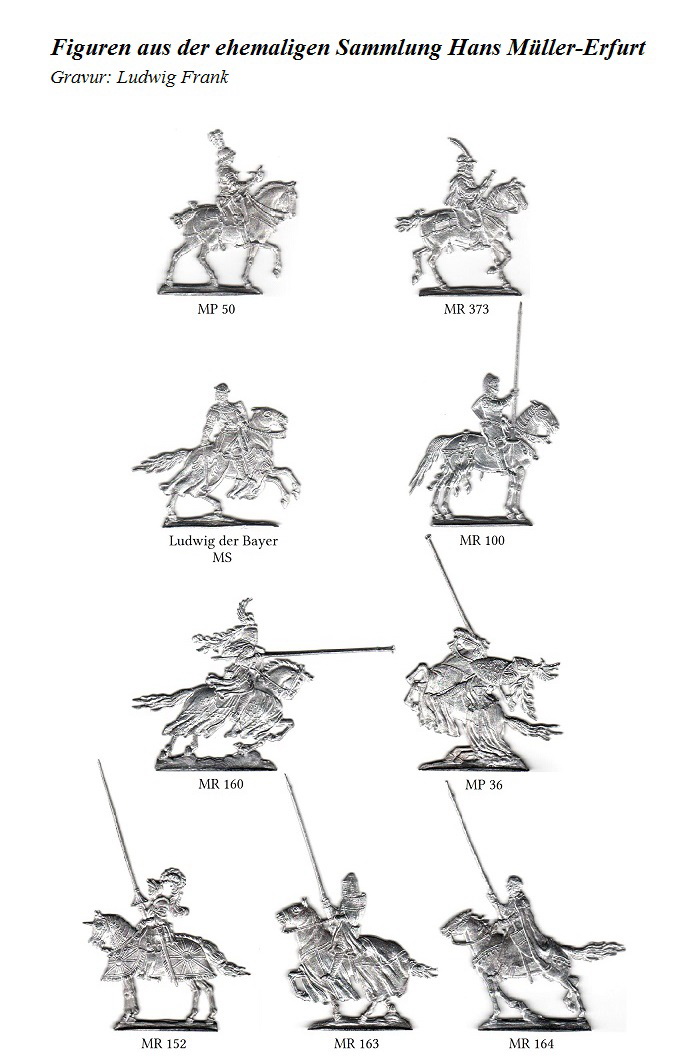
Hans Müller (Erfurt) Figures
In more or less chronological order
Figuren von Hans Müller (Erfurt)
In mehr oder weniger chronologischer Reihenfolge
Medieval Flats - Zinnfiguren – made by Hans Müller of Erfurt
Among the most popular medieval and 30 Years War “flat figures”, or “’flats” (in German: Zinnfiguren), still today are those produced by Hans Müller (1885-1968) from Erfurt which during his lifetime was in the German Empire (Reich) and then the former German Democratic Republic (GDR). Müller, or Mueller, produced flats from 1927 to 1957. He specialized in the Thirty Years War (1618-48), “Turkish Wars” (15th-17th Centuries) and the Middle Ages (12th-15th Centuries), as well as doing a tangent to produce some figures addressing Mexican guerrillas in the mid-19th Century.
This section deals almost exclusively with his figures from the Middle Ages. Müller produced approximately 470 unique medieval figures, which were mostly drawn by top artist Ludwig Madlener (1903-1976) and engraved by Ludwig Frank (1870-1957), who is considered by many to be the finest ever engraver of flats. Especially noteworthy among the medieval figures are those for the Crusades, the 1386 Battle of Crecy and the 1410 Battle of Tannenberg/Grunwald, as well as the 14th Century tournament series.
For many collectors, Müller’s castings are considered to be the most beautiful figures for this period, having employed top-notch artists and engravers. Unfortunately, when he ceased production, the molds were sold to a number of other producers and it became very daunting to determine from whom the figures could be purchased. Happily, one can now identify the producers of the vast majority of the medieval figures if you have access to an article in the German national figure club, KLIO magazine Die Zinnfigur, run in four parts in the November/December 2019 to April/May 2020 issues. Of course that producer listing will become outdated if any of the molds change hands.
Starting in 1954, Müller’s figures were available through the Cultural Union of the GDR (Kulturbund der DDR), which was the Communist government’s approved group that could trade figures within the GDR and also exchange figures for ones from the West, but on a basis far more lucrative for the East. In Hans Müller’s obituary in a 1968 edition of the Die Zinnfigur magazine, it stated that “for obvious reasons, after the war, he had to struggle with numerous difficulties, so that the focus of his work shifted from figures to the study of castles and he developed a comprehensive database on castles.”
It’s also noteworthy that Hans Müller was not just a producer or ‘editor’ of figures, but he was a very active a collector, painter, diorama builder and subject matter expert. He started writing articles for German figure magazines in the 1920s, focusing on the Thirty Years War. (Yes, Die Zinnfigur has was published at least 1920, with a brief hiatus during WWII!) Starting in the early 1930s, Müller began added the Middle Ages to his offerings. He did detailed research for his figures and was highly regarded for their authenticity and artistic quality. He was often noted for building dioramas about the Thirty Years War (which was having its tricentennial) and displayed them at major Zinnfiguren events, such as the national exhibitions in 1929, 1930 (in Leipzig), 1931 (in Hamburg) etc.. He also sold his figures in large quantities, with a special price for “50” of the same figure (dioramas were big in the 1930s).
It appears Müller had already ceased producing and selling figures by 1957, or at least had less to do with them. From that period on until his death on 26 June 1968, his molds were acquired by others, probably starting in 1957. Some stayed in what was then the GDR, while others were acquired by producers in the West. They were taken over by H. G. Ellfeldt, (Stuttgart, West Germany), Matthias Frenzel (Meissen, GDR), Heinz Tetzel (Magdeburg, GDR), Heinz Bittner (Halle, GDR), Erwin Ortmann (Weimar, GDR), F.C. Neckel (then in Wendlingen/Neckar, West Germany), Dr. Curt Kollbrunner (Zöllikon, Switzerland), Dr. Horst Neumeister (Merbitz bei Nauendorf, GDR), and above all, Fritz Menz (Burg, GDR).
Because the figures from the molds that remained in the GDR could only be obtained through the official “Kulturbund” exchange system, it made it very challenging to obtain them in the West. Later, most of the molds for the 12th-13th century, Gothic and Saracen/Turkish medieval figures were acquired by Fritz Menz, then passed to his daughter Irene Menz-Wille (in Iserlohn), who later sold them to Frau Kirsten Howey (Burg bei Magdeburg). The 14th and 15th century figures made their way in part to Heinz Neumeister (Magdeburg, GDR) and the majority passed through Erwin Ortmann and several other producers to Hans Schwahn (Dessau and Russia) who eventually obtained the molds for the 15th century “Arkeley-Büchse” (culverin artillery) and its crew. Additionally, Wolfgang Friedrich had some of the figures in his offerings. In 2024, the numerous molds held by Tetzel were acquired by Kristen and Hardy Howey and are now more readily available! The Howeys also commissioned Wolfgang Friedrich to engrave a formerly unpublished figure designed by Madlener or Ludwig Frank of a Gothic knight which is identified as MR314 and shown below, painted by Henry Schmidt of Berlin. The forms for the Thirty Years War were taken over by Richard Wünsch (Halle), and then by Herr Werner Fechner in 2017 (see http://www.fechner-zinnfiguren.de/frames.php).
The Müller figures can be challenging to identify although they almost always feature a diamond-shaped base, and generally include Ludwig Frank’s “LFrk” initials (if he was the engraver) and an identifying figure number. The initials or marking of the illustrator, generally Ludwig Madlener, are not provided. The figures for the Middle Ages are grouped and marked on their bases as follows:
Ma-Mw = Special Figures (General) (Sonderfiguren allgemein) (primarily medieval, i.e., 13 of these 19 figures)
MP = Medieval Portrait (Sonderfiguren Mittelalter - Portrait) – 111 figures
MR = Knights (Ritter) (about 300 figures, but some appear with the code “MF”)
MT = Medieval Turks (Türken) (35 figures; Saracens including for the late Middle Ages)
The Thirty Years War appear with “M” and “MB” markings, while a series on Mexico are marked as “MSo” for “Mexico Sonora”.
As one can imagine, the markings on the old castings are often barely recognizable, or even unrecognizable, or are completely missing.
As mentioned above, the Müller-Erfurt figures only bear the initials or marking of the engraver, e.g., for Ludwig Frank, Joachim Emmerling, or Franz Karl Mohr (1896-1970). However, the initials of the artists who drew the figures essentially do not appear, most noteworthy, the absence of those of Ludwig Madlener who designed the vast majority of the figures. For the early figures, produced from 1927 to 1938-39, Ludwig Frank also personally prepared some of the drawings. The drawing of Sultan Saladin was based on the plate by Doré, the illustrations for the individual Ottoman Turks were derived from Richard Knötel’s uniform plates in the Uniformenkunde series, while some of the figures of medieval Russians were copied from or based on the plates by the Russian artist A.V. Viskovatov, published around 1899.[1]
For those who have Michael Taylor’s book “The Art of the Flat in Figure,” you can find photos of some of Hans Müller’s figures, including some painted by the renowned flats painter Walter Fischer. But note that he attributes them to Irene Menz-Wille, who took over the molds.[2] Erwin Ortmann’s “The Collector’s Guide to Model Tin Figures” also features his figures, but he cites the artist Ludwig Madlener and engraver Ludwig Frank rather than the producer, Hans Müller.[3]
The Müller figures are currently available from the following producers, but one must consult their catalogues – if they have one – to determine which figures they sell. It should be mentioned that many of the figures are available from the Berliner Zinnfiguren company in Berlin, but only as sets. Most of the vendors’ web sites - if they have one - are viewable in English.
Zinnfiguren “Fritz Menz” Burg (Fr. Kirsten Howey) - www.zinnfigurenfreunde-burg.de/images/offizin/menzkat.htm - these are primarily figures from the 12th and 13th centuries (early crusades)
Hans Schwahn – no link – Kreisstrasse 9c, -06844 Dessau (Anhalt) – mostly 14th century knights (100 Years War), 1410 Battle of Tannenberg/Grunwald (Teutonic Order, Poles, Lithuanians, Russians, etc.), bombard and crew, and Gothic (15th C.) figures.
Schmalkalder Zinnfiguren (Dittmar) - www.schmalkalder-zinnfiguren.de – about a dozen Gothic period knights.
Wolfgang Friedrich - www.zinnfigurenfreunde-leipzig.de/her/wf.htm - see „ehem.Müller“ (http://www.zinnfigurenfreunde-leipzig.de/her/wf/wk-29.jpg) for nine various mounted knights.
Magdeburger Zinnfiguren – no link - Heinz Dieter Tetzel, Wespenstieg 2, 39120 Magdeburg, Germany – Tournament ca. 1450 with jousting knights, spectators, civilians celebrating, courtly nobles, artisans and armorers (see Ortmann, pp. 101-105 for examples), but this vendor is generally unwilling to sell to anyone he doesn’t already know!
Wolfgang Unger - no link – Feuerbachstr. 21, D-04105 Leipzig, Germany – only one or two figures and no catalogue.
Berliner Zinnfiguren (for sale of Müller’s figures in sets only) - www.zinnfigur.com
For those interested in more information about the Müller (Erfurt) medieval figures, there is a publication in the works which should be available in August 2021. It should include a listing and photos of all the figures with information on the timeframe, country/group represented, engraver, vendor and remarks. It will also feature color photos of Müller figures painted by eight or more collectors including a number who are master painters. The work will be a softcover edition and is planned to go on sale at the 2021 Kulmbach figure festival. It will be in German, but it may also include an English synopsis.
The pictures on this page are primarily from the author’s collection, including figures by former NCMSS (then NCMC) member Tom Yuskiw (1941-1989) who did his figures using printer’s inks (!) rather than oils or acrylics. Also included are some figures painted and generously provided by Herb Kuehlwein, formerly of Newport News and now of Tucson, AZ.
This article was based on the earlier work of and information provided by Frau/Mrs. Kirsten Howey and Herren/Misters Rüdiger Engel, Henry Schmidt, Hans Schwahn, and Hardy Howey, to whom I owe thanks. I am grateful to them as well as to Alexander Baden, Christian Otto and especially to Karl-Werner Rieger and Manfred Levec for their assistance.
Footnotes:
[1] Viskovatov, A. V., Istoricheskoye opisaniye Odeschdi I Voorrusheniya Rossiyskikh Voisk“ (St. Petersburg: V. S. Balaschev & Co., 1899).
[2] Taylor, Michael, The Art of the Flat Tin Figure (London: Windrow & Greene, 1995), pp. 6, 13, 67, 83, 92, 114, 119.
[3] Ortmann, Erwin, The Collector’s Guide to Model Tin Figures (New York: Putnam & Sons, 1974), pp.97, 101-105, 114, 180.
Among the most popular medieval and 30 Years War “flat figures”, or “’flats” (in German: Zinnfiguren), still today are those produced by Hans Müller (1885-1968) from Erfurt which during his lifetime was in the German Empire (Reich) and then the former German Democratic Republic (GDR). Müller, or Mueller, produced flats from 1927 to 1957. He specialized in the Thirty Years War (1618-48), “Turkish Wars” (15th-17th Centuries) and the Middle Ages (12th-15th Centuries), as well as doing a tangent to produce some figures addressing Mexican guerrillas in the mid-19th Century.
This section deals almost exclusively with his figures from the Middle Ages. Müller produced approximately 470 unique medieval figures, which were mostly drawn by top artist Ludwig Madlener (1903-1976) and engraved by Ludwig Frank (1870-1957), who is considered by many to be the finest ever engraver of flats. Especially noteworthy among the medieval figures are those for the Crusades, the 1386 Battle of Crecy and the 1410 Battle of Tannenberg/Grunwald, as well as the 14th Century tournament series.
For many collectors, Müller’s castings are considered to be the most beautiful figures for this period, having employed top-notch artists and engravers. Unfortunately, when he ceased production, the molds were sold to a number of other producers and it became very daunting to determine from whom the figures could be purchased. Happily, one can now identify the producers of the vast majority of the medieval figures if you have access to an article in the German national figure club, KLIO magazine Die Zinnfigur, run in four parts in the November/December 2019 to April/May 2020 issues. Of course that producer listing will become outdated if any of the molds change hands.
Starting in 1954, Müller’s figures were available through the Cultural Union of the GDR (Kulturbund der DDR), which was the Communist government’s approved group that could trade figures within the GDR and also exchange figures for ones from the West, but on a basis far more lucrative for the East. In Hans Müller’s obituary in a 1968 edition of the Die Zinnfigur magazine, it stated that “for obvious reasons, after the war, he had to struggle with numerous difficulties, so that the focus of his work shifted from figures to the study of castles and he developed a comprehensive database on castles.”
It’s also noteworthy that Hans Müller was not just a producer or ‘editor’ of figures, but he was a very active a collector, painter, diorama builder and subject matter expert. He started writing articles for German figure magazines in the 1920s, focusing on the Thirty Years War. (Yes, Die Zinnfigur has was published at least 1920, with a brief hiatus during WWII!) Starting in the early 1930s, Müller began added the Middle Ages to his offerings. He did detailed research for his figures and was highly regarded for their authenticity and artistic quality. He was often noted for building dioramas about the Thirty Years War (which was having its tricentennial) and displayed them at major Zinnfiguren events, such as the national exhibitions in 1929, 1930 (in Leipzig), 1931 (in Hamburg) etc.. He also sold his figures in large quantities, with a special price for “50” of the same figure (dioramas were big in the 1930s).
It appears Müller had already ceased producing and selling figures by 1957, or at least had less to do with them. From that period on until his death on 26 June 1968, his molds were acquired by others, probably starting in 1957. Some stayed in what was then the GDR, while others were acquired by producers in the West. They were taken over by H. G. Ellfeldt, (Stuttgart, West Germany), Matthias Frenzel (Meissen, GDR), Heinz Tetzel (Magdeburg, GDR), Heinz Bittner (Halle, GDR), Erwin Ortmann (Weimar, GDR), F.C. Neckel (then in Wendlingen/Neckar, West Germany), Dr. Curt Kollbrunner (Zöllikon, Switzerland), Dr. Horst Neumeister (Merbitz bei Nauendorf, GDR), and above all, Fritz Menz (Burg, GDR).
Because the figures from the molds that remained in the GDR could only be obtained through the official “Kulturbund” exchange system, it made it very challenging to obtain them in the West. Later, most of the molds for the 12th-13th century, Gothic and Saracen/Turkish medieval figures were acquired by Fritz Menz, then passed to his daughter Irene Menz-Wille (in Iserlohn), who later sold them to Frau Kirsten Howey (Burg bei Magdeburg). The 14th and 15th century figures made their way in part to Heinz Neumeister (Magdeburg, GDR) and the majority passed through Erwin Ortmann and several other producers to Hans Schwahn (Dessau and Russia) who eventually obtained the molds for the 15th century “Arkeley-Büchse” (culverin artillery) and its crew. Additionally, Wolfgang Friedrich had some of the figures in his offerings. In 2024, the numerous molds held by Tetzel were acquired by Kristen and Hardy Howey and are now more readily available! The Howeys also commissioned Wolfgang Friedrich to engrave a formerly unpublished figure designed by Madlener or Ludwig Frank of a Gothic knight which is identified as MR314 and shown below, painted by Henry Schmidt of Berlin. The forms for the Thirty Years War were taken over by Richard Wünsch (Halle), and then by Herr Werner Fechner in 2017 (see http://www.fechner-zinnfiguren.de/frames.php).
The Müller figures can be challenging to identify although they almost always feature a diamond-shaped base, and generally include Ludwig Frank’s “LFrk” initials (if he was the engraver) and an identifying figure number. The initials or marking of the illustrator, generally Ludwig Madlener, are not provided. The figures for the Middle Ages are grouped and marked on their bases as follows:
Ma-Mw = Special Figures (General) (Sonderfiguren allgemein) (primarily medieval, i.e., 13 of these 19 figures)
MP = Medieval Portrait (Sonderfiguren Mittelalter - Portrait) – 111 figures
MR = Knights (Ritter) (about 300 figures, but some appear with the code “MF”)
MT = Medieval Turks (Türken) (35 figures; Saracens including for the late Middle Ages)
The Thirty Years War appear with “M” and “MB” markings, while a series on Mexico are marked as “MSo” for “Mexico Sonora”.
As one can imagine, the markings on the old castings are often barely recognizable, or even unrecognizable, or are completely missing.
As mentioned above, the Müller-Erfurt figures only bear the initials or marking of the engraver, e.g., for Ludwig Frank, Joachim Emmerling, or Franz Karl Mohr (1896-1970). However, the initials of the artists who drew the figures essentially do not appear, most noteworthy, the absence of those of Ludwig Madlener who designed the vast majority of the figures. For the early figures, produced from 1927 to 1938-39, Ludwig Frank also personally prepared some of the drawings. The drawing of Sultan Saladin was based on the plate by Doré, the illustrations for the individual Ottoman Turks were derived from Richard Knötel’s uniform plates in the Uniformenkunde series, while some of the figures of medieval Russians were copied from or based on the plates by the Russian artist A.V. Viskovatov, published around 1899.[1]
For those who have Michael Taylor’s book “The Art of the Flat in Figure,” you can find photos of some of Hans Müller’s figures, including some painted by the renowned flats painter Walter Fischer. But note that he attributes them to Irene Menz-Wille, who took over the molds.[2] Erwin Ortmann’s “The Collector’s Guide to Model Tin Figures” also features his figures, but he cites the artist Ludwig Madlener and engraver Ludwig Frank rather than the producer, Hans Müller.[3]
The Müller figures are currently available from the following producers, but one must consult their catalogues – if they have one – to determine which figures they sell. It should be mentioned that many of the figures are available from the Berliner Zinnfiguren company in Berlin, but only as sets. Most of the vendors’ web sites - if they have one - are viewable in English.
Zinnfiguren “Fritz Menz” Burg (Fr. Kirsten Howey) - www.zinnfigurenfreunde-burg.de/images/offizin/menzkat.htm - these are primarily figures from the 12th and 13th centuries (early crusades)
Hans Schwahn – no link – Kreisstrasse 9c, -06844 Dessau (Anhalt) – mostly 14th century knights (100 Years War), 1410 Battle of Tannenberg/Grunwald (Teutonic Order, Poles, Lithuanians, Russians, etc.), bombard and crew, and Gothic (15th C.) figures.
Schmalkalder Zinnfiguren (Dittmar) - www.schmalkalder-zinnfiguren.de – about a dozen Gothic period knights.
Wolfgang Friedrich - www.zinnfigurenfreunde-leipzig.de/her/wf.htm - see „ehem.Müller“ (http://www.zinnfigurenfreunde-leipzig.de/her/wf/wk-29.jpg) for nine various mounted knights.
Magdeburger Zinnfiguren – no link - Heinz Dieter Tetzel, Wespenstieg 2, 39120 Magdeburg, Germany – Tournament ca. 1450 with jousting knights, spectators, civilians celebrating, courtly nobles, artisans and armorers (see Ortmann, pp. 101-105 for examples), but this vendor is generally unwilling to sell to anyone he doesn’t already know!
Wolfgang Unger - no link – Feuerbachstr. 21, D-04105 Leipzig, Germany – only one or two figures and no catalogue.
Berliner Zinnfiguren (for sale of Müller’s figures in sets only) - www.zinnfigur.com
For those interested in more information about the Müller (Erfurt) medieval figures, there is a publication in the works which should be available in August 2021. It should include a listing and photos of all the figures with information on the timeframe, country/group represented, engraver, vendor and remarks. It will also feature color photos of Müller figures painted by eight or more collectors including a number who are master painters. The work will be a softcover edition and is planned to go on sale at the 2021 Kulmbach figure festival. It will be in German, but it may also include an English synopsis.
The pictures on this page are primarily from the author’s collection, including figures by former NCMSS (then NCMC) member Tom Yuskiw (1941-1989) who did his figures using printer’s inks (!) rather than oils or acrylics. Also included are some figures painted and generously provided by Herb Kuehlwein, formerly of Newport News and now of Tucson, AZ.
This article was based on the earlier work of and information provided by Frau/Mrs. Kirsten Howey and Herren/Misters Rüdiger Engel, Henry Schmidt, Hans Schwahn, and Hardy Howey, to whom I owe thanks. I am grateful to them as well as to Alexander Baden, Christian Otto and especially to Karl-Werner Rieger and Manfred Levec for their assistance.
Footnotes:
[1] Viskovatov, A. V., Istoricheskoye opisaniye Odeschdi I Voorrusheniya Rossiyskikh Voisk“ (St. Petersburg: V. S. Balaschev & Co., 1899).
[2] Taylor, Michael, The Art of the Flat Tin Figure (London: Windrow & Greene, 1995), pp. 6, 13, 67, 83, 92, 114, 119.
[3] Ortmann, Erwin, The Collector’s Guide to Model Tin Figures (New York: Putnam & Sons, 1974), pp.97, 101-105, 114, 180.
The Crusades and up to 1346
Die Kreuzzüge und bis zum Jahre 1346
Crusaders ca. 1100 / Kreuzritter um 1100
painted by: / Bemalung: Tom Yuskiw (* 1941 - † 1989)
MP2 -Bohemond of Taranto (1054-1111), Prince of Taranto and of Antioch, a leader of the 1st Crusade
MP2 -Beomund von Tarant (1054-1111), Prinz von Taranto und von Antiochien. ein Führer des. 1. Kreuzzugs
MP10 Raymond IV of Toulouse, 1st Crusade
Raymond of Saint-Gilles (c. 1041 – 28 February 1105), also called Raymond IV of Toulouse or Raymond I of Tripoli, was the count of Toulouse, duke of Narbonne, and margrave of Provence from 1094, and one of the leaders of the First Crusade from 1096 to 1099.
MP10 was produced in 1936 after the etching "The Battle of Nicea" by Gustave Doré,
Painted by Dr. Thomas Brümmer (Halle, Germany)
MP10 Raimund IV. von Toulouse, 1. Kreuzzug
Raimond von Toulouse (geb. 1041 – 28. Februar 1105), auch Raimund IV von Saint-Gilles oder Raimund I von Tripoli genannt, war der Graf von Toulouse, Herzog von Narbonne, und Margraf von Provence ab1094, und einer der Führer des 1. Kreuzzuges von 1096 bis 1099.
MP10 wurde 1931 von Hans Müller (Erfurt) hergestellt, und von Ludwig Frank, - nach Gustave Dorés Stich "Die Schlacht vonf Nicea", graviert; Bemalung: Dr. Thomas Brümmer (Halle)
Raymond of Saint-Gilles (c. 1041 – 28 February 1105), also called Raymond IV of Toulouse or Raymond I of Tripoli, was the count of Toulouse, duke of Narbonne, and margrave of Provence from 1094, and one of the leaders of the First Crusade from 1096 to 1099.
MP10 was produced in 1936 after the etching "The Battle of Nicea" by Gustave Doré,
Painted by Dr. Thomas Brümmer (Halle, Germany)
MP10 Raimund IV. von Toulouse, 1. Kreuzzug
Raimond von Toulouse (geb. 1041 – 28. Februar 1105), auch Raimund IV von Saint-Gilles oder Raimund I von Tripoli genannt, war der Graf von Toulouse, Herzog von Narbonne, und Margraf von Provence ab1094, und einer der Führer des 1. Kreuzzuges von 1096 bis 1099.
MP10 wurde 1931 von Hans Müller (Erfurt) hergestellt, und von Ludwig Frank, - nach Gustave Dorés Stich "Die Schlacht vonf Nicea", graviert; Bemalung: Dr. Thomas Brümmer (Halle)
Berengaria of Navarro / von Navarra
Berengaria of Navarro (MP12), Spanish: Berenguela; French: Bérengère, born between 1165 and 1170; † 1230, was the wife of King Richard"the Lionhearted" from 1191 until 1199 as the queen of England. Berengaria war die älteste Tochter von König Sancho VI. „dem Weisen“ von Navarra und Sancha von Kastilien, der Tochter von Alfons VII. von Kastilien-León und Berenguela von Barcelona.
Berengaria von Navarra (MP12), spanisch: Berenguela; französisch: Bérengère, geboren zwischen 1165 und 1170; † 1230, war als Gattin von König Richard Löwenherz von 1191 bis 1199 Königin von England. Berengaria war die älteste Tochter von König Sancho VI. „dem Weisen“ von Navarra und Sancha von Kastilien, der Tochter von Alfons VII. von Kastilien-León und Berenguela von Barcelona.
MP12, painted by Mike Taylor (†) (UK) in the collection of Bernd Pratt (Schwerin)
Crusader ca. 1150 - Kreuzfahrer um 1150
(MR151 combination figure - Kombifigur)
MP33 -Richard I, King of England "Lionheart" (1157-1199), the leader of the English on the 3rd Crusade
MP33 -Richard I. König von England "Löwenherz" (1157-1199), der Führer der Engländer auf dem 3. Kreuzzug
Mm -Frederick Barbarossa (1123-1190), Holy Roman Emperor 1152-1190.
Mm -Friedrich Barbarossa (1123-1190), Kaiser des Heiligen Römischen Reiches Deutscher Nation 1152-1190.
30mm flat painted by Angelo Amorese, Verona, Italy
30mm Flachfigur, Bemalung: Angelo Amorese, Verona Italien
Mm -Friedrich Barbarossa (1123-1190), Kaiser des Heiligen Römischen Reiches Deutscher Nation 1152-1190.
30mm flat painted by Angelo Amorese, Verona, Italy
30mm Flachfigur, Bemalung: Angelo Amorese, Verona Italien
MP1 KIladj Arslan the Sultan of Iconius - KIladj Arslan der Sultan von Ikonius
30mm flat painted by Angelo Amorese, Verona, Italy
30mm Flachfigur, Bemalung: Angelo Amorese, Verona Italien
30mm flat painted by Angelo Amorese, Verona, Italy
30mm Flachfigur, Bemalung: Angelo Amorese, Verona Italien
Mg Arab Aga mounted- Arabischer Agha beritten
30mm flat painted by Günter Schaaf (*1936 †2019) in 1999, Mannheim, Germany
30mm Flachfigur, Bemalung: Günter Schaaf
30mm flat painted by Günter Schaaf (*1936 †2019) in 1999, Mannheim, Germany
30mm Flachfigur, Bemalung: Günter Schaaf
MP7 Saladin on foot (reigned 1174-1193), MP9 Rashid al-Din Sinan (1133/35-1193) the leader of the Assassins sect, MP1 KIladj Arslan the Sultan of Iconius
30mm flat painted by Roland König, Kulmbach
MP7 Saladin zu Fuß (reg. 1174-1193), MP9 Rashid al-Din Sinan (1133/35- 1193) der Assassinen-Sektenführer, MP1 KIladj Arslan der Sultan von Ikonius
30mm Flachfigur, Bemalung: Roland König, Kulmbach
30mm flat painted by Roland König, Kulmbach
MP7 Saladin zu Fuß (reg. 1174-1193), MP9 Rashid al-Din Sinan (1133/35- 1193) der Assassinen-Sektenführer, MP1 KIladj Arslan der Sultan von Ikonius
30mm Flachfigur, Bemalung: Roland König, Kulmbach
MT9 Saracen lancer, 12th Century - Sarazener Lanzenreiter, 12. Jahrhundert
30mm flat painted by Roland König, Kulmbach
30mm Flachfigur, Bemalung: Roland König, Kulmbach
30mm flat painted by Roland König, Kulmbach
30mm Flachfigur, Bemalung: Roland König, Kulmbach
The peasant levy series, drawn and engraved by Johannes Frauendorf for Hans Müller.
Die "Bauernheerbann" Serie von Johannes Frauendorf gezeichnet und graviert für Hans Müller.
30mm flats (MR202 - MR234)
Die "Bauernheerbann" Serie von Johannes Frauendorf gezeichnet und graviert für Hans Müller.
30mm flats (MR202 - MR234)
Teutonic Knight ca. 1300 - Ordensritter um 1300 (MR164)
Teutonic Knight ca. 1300 - Ordensritter um 1300 (left to right MR37, MR38, MR39 in left photo)
30mm flat figures designed by L. Madlener and engraved by Ludwig Frank ca. 1932 after etchings by Gustav Doré
Painted by/Bemalung: Christian Bertulat, Dresden
30mm flat figures designed by L. Madlener and engraved by Ludwig Frank ca. 1932 after etchings by Gustav Doré
Painted by/Bemalung: Christian Bertulat, Dresden
Tournament Knight charging - Turnierritter angreifend (MR160)
MR50 and MR41 painted by / Bemalung: Christian Bertulat, Dresden
Left and far right (MR50): early 14th century, inspired by the Codex Manesse
Center (MR41): count Louis II of Loos 1216, inspired by Men-at-Arms 310, German Medieval armies
Links und ganz rechts (MR50): frühes 14. Jahrhundert, inspiriert durch den Codex Manesse
Mitte (MR41): Graf Louis II von Loos 1216, vergl. Men-at-Arms 310, German Medieval armies
Painted by/Bemalung: Christian Bertulat, Dresden
Left and far right (MR50): early 14th century, inspired by the Codex Manesse
Center (MR41): count Louis II of Loos 1216, inspired by Men-at-Arms 310, German Medieval armies
Links und ganz rechts (MR50): frühes 14. Jahrhundert, inspiriert durch den Codex Manesse
Mitte (MR41): Graf Louis II von Loos 1216, vergl. Men-at-Arms 310, German Medieval armies
Painted by/Bemalung: Christian Bertulat, Dresden
MR51 and MR 160 painted by / Bemalung: Angelo Amorese, Verona, Italy
MP103 and MP105, Tournament knights/Turnierritter
Painted by / Bemalung: Angelo Amorese, Verona, Italy
MR 91 Bishop/Bischof - painted by / Bemalung: Oleg Sokruto, Canada
Queen ca 1350; Empress Ann, 1281, & court lady
Königin (um 1350), Kaiserin Ann, 1281 & Hofdame
(MP40, MP39 & MP41)
Königin (um 1350), Kaiserin Ann, 1281 & Hofdame
(MP40, MP39 & MP41)
Battle of Crecy 1346 and 100 Years War
Schlacht bei Crecy 1346 und 100jähriger Krieg
King Edward III of England - König Edward III. von England (MP17)
Left by/links Ben.: Rick Sanders - Right by/rechts Ben.: Renaud Chaleon (Paris, F)
English knights - Englische Ritter (MR94, MR95 & MR108)
Left by/links Bem.: Renaud Chaleon (Paris, F) - Center & ight by/Mitte & rechts Bem.: Rick Sanders
English or French knight - englischer oder französischer Ritter (MR99)
Painted by/Bem.: Renaud Chaleon (Paris, F)
Welsh man-at-arms - Walliser Fußknecht (MR9)
Left by/links Ben.: Renaud Chaleon (Paris, F) - Center & ight by/Mitte & rechts Ben.: Rick Sanders
English or French man-at-arms - englischer oder französischer Fußknecht (MR61)
Painted by/Bem.: Renaud Chaleon (Paris, F)
English longbow archer - englischer Langbogen-Schütze (MR11 & MR87)
Left by/links Ben.: Rick Sanders - Right by/rechts Ben.: Renaud Chaleon (Paris, F)
English longbow archers - englischer Langbogen-Schützen (MR10, MR87, MR88, MR89)
English archer's barrier for Crecy
Englisches Pickettpfahlindernis für Crecy (MR13)
English knight - Englischer Ritter (MR8)
Left by/links Ben.: Rick Sanders - Right by/rechts Ben.: Renaud Chaleon (Paris, F)
French knight - französischer Ritter (Mv)
French knight - französischer Ritter (MR106)
French knights - französische Ritter (MR71 & MR100 with flag added)
Painted by/Bemalung: Renaud Chaleon (Paris, F)
French knights - französische Ritter (Mu left/ links & MR80 right/rechts)
Painted by/Bemalung: Alexander Glöckner, Karlsruhe
Blind King John of Bohemia originally from France, who fought and died at Crécy 1346 /
König Johann der Blinde v. Böhmen, ursprünglich aus Frankreich, der bei Crécy 1346 kämpfte und fiel (MP20)
Genoese crossbowmen in French service
Genueser Armbrustschütze im französischen Dienst
MR85 Left by/links Ben.: Rick Sanders - MR86 Right by/rechts Ben.: Renaud Chaleon (Paris, F)
Genueser Armbrustschütze im französischen Dienst
MR85 Left by/links Ben.: Rick Sanders - MR86 Right by/rechts Ben.: Renaud Chaleon (Paris, F)
Knight advancing with spear & shield (MR67) and Man attacking with mace (MR95)
Mann vorgehend mit Spieß (MR67) und Mann mit Keule angreifend (MR95)
Both engraved in the 1930s by Ludwig Frank. The source for MR95 was from the English paper puppet series “Great Gallery of Historic Costumes“ (man on right).
Beide wurden in der 1930er Jahren von Ludwig Frank graviert. Die Vorlage für MR95 war aus der englischen Papierpuppenserie „Great Gallery of Historic Costumes“ (Typ rechts).
The Rise of Plate Armor 1370 -1420
Knight in scale armor - Ritter in Schuppenpanzer (MR65)
Townsmen with glaves and man-at-arms with halberd fighting
Bürger mit Gelbe und Mann mit Hellebarde fechtend
MR46, MR47 and MR173 painted by/Ben.: Renaud Chaleon (Paris, F)
Bürger mit Gelbe und Mann mit Hellebarde fechtend
MR46, MR47 and MR173 painted by/Ben.: Renaud Chaleon (Paris, F)
The Battle of Tannenberg/Grunwald - Die Schlacht bei Tannenberg - 1410
The Teutonic Order vs. the combined Polish-Lithuanian and Russian armies
Teutonic Knight - Ordersritter (MR138)
Teutonic Knight Commander - Komtur des Deutschordens (MP26)
Teutonic Knight - Ordensritter (MR57)
Standard-bearer of the Bishopric of Warmia (allied levy)
Bannerträger des Bistums Ermland (verbündeter Aufgebot)
MR129 w/ attached "h" flag
Bannerträger des Bistums Ermland (verbündeter Aufgebot)
MR129 w/ attached "h" flag
Teutonic Order trumpeter
Ordensritter Trompeter
(MR130)
Painted by/Bemalung Angelo Amorese (Verona, Italy)
Ordensritter Trompeter
(MR130)
Painted by/Bemalung Angelo Amorese (Verona, Italy)
Teutonic Order Sarjant or Grey Cloak crossbowman
Deutschorden Sarjantbruder oder Graumäntler Armbruster
(MR128)
Deutschorden Sarjantbruder oder Graumäntler Armbruster
(MR128)
Teutonic Knight - Ordensritter (MR153 & MR154))
Mounted crossbowman, Lithuanian horseman (as Teutonic Order Sarjant), Teutonic Order trumpeter
Berittene Schützen, Litauer Reiter (Dt. Orden Sarjant) & Ordensritter Trompeter
(MR128, MR134, MR130)
Painted by/Bemalung Angelo Amorese (Verona, Italy)
Berittene Schützen, Litauer Reiter (Dt. Orden Sarjant) & Ordensritter Trompeter
(MR128, MR134, MR130)
Painted by/Bemalung Angelo Amorese (Verona, Italy)
The Combined Polish-Lithuanian Army
Das gemeinsame polnisch-litauische Heer
Polish knight with banner - polnischer Ritter mit Banner (MP23)
Polish knight - polnischer Ritter (MP38)
See also/Seihe auch "Other Painters --> Angelo Amorese
Polish knight - polnischer Ritter (MR70)
Lithuanian knight with banner of the Gate or Columns of Gedymin
Litauer Ritter mit Banner mit dem Tor oder den Säulen Gedymins (MP27)
Lithuanian knights - Litauer Ritter (MR135 & MR133)
Lithuanian knight - Litauer Ritter (MR142)
Allied Russians - Verbündete Russen
The following Russian commanders and troops are primarily based on the plates of A.V. Viskovatov's plates produced in the 1850s and are from Romanovempire.org.
Die folgende russische Heerführer und Krieger, die für den 14. bis 17. Jahrhundert darstellend sind, stammen vor allem von den in den 1850er Jahren von A.W. Wiskowatow gefertigten Tafeln. Quelle der Abbildungen ist Romanovempire.org.
Russian Voivode (prince) (MP14) and inspiring Viskovatov plate
Russische Heerführer (Woiwode) im Überpanzr mit Eisenpanzerung und Glocken-Prunkhelm (MP14) und Wiskowatow Tafel Quelle
Russian warrior in mail and plate amor and pointed helmet with chain ventail (MR113) and source Viskovatov plate
Russische Krieger in Ketten-Plattenrüstug und Spitzhelm mit Kettenbehang (MR113) und Wiskowatow Tafel Quelle
Russian warrior in mail and plate armor and spherical helmet (MR114) and source Viskovatov plate
Russische Krieger im Ketten-Plattenrüstug und mit Rundhelm (MR114) und Wiskowatow Tafel Quelle
Russian commander (viovode) in double chainmail armor and bell-shaped helmet and source Viskovatov plate
Russische Heerführer (Woiwode) im Doppelkettenhemd und mit Glocken-Prunkhelm (MR115) und Wiskowatow Tafel Quelle
Russian warrior in extra breastplate and spherical helmet with nasal (MR116) and source Viskovatov plate
Russische Krieger im Überpanzer und mit Rundhelm mit Nasenschutz (MR116) und Wiskowatow Tafel Quelle
Russian pikemen and inspiring Viskovatov plate
Russische Spießer und Vorbild Wiskowatow Tafel
(MR120, MR147, MR148 above/oben; MR119 below/unten)
Russische Spießer und Vorbild Wiskowatow Tafel
(MR120, MR147, MR148 above/oben; MR119 below/unten)
Russian bowman in woolen hat and inspiring Viskovatov plate
Russische Bogner in Wollmütze und Wiskowatow Tafel Quelle (MR117)
Russian warriors with long axe in source plate by A. Kretschmer (below)
Russische Krieger mit Langäxte nach A. Kretschmers Tafel (unten)
(left/links MR176; right/rechts MR178 )
Russische Krieger mit Langäxte nach A. Kretschmers Tafel (unten)
(left/links MR176; right/rechts MR178 )
Russian warrior with long axe (and Bohemian shield) in source plate by A. Kretschmer
Russische Krieger mit Langaxt (und böhmischem Schild) nach A. Kretschmers Tafel
(MR177 )
Russische Krieger mit Langaxt (und böhmischem Schild) nach A. Kretschmers Tafel
(MR177 )
Russian bowman halted and inspiring Viskovatov plate
30mm flat painted by Henry Schmidt (Berlin), photo: R. Sanders
Russische Bogner, halt, und Wiskowatow Tafel Quelle (MR118)
30mm Flachfigur, Bemalung: Henry Schmidt (Berlin), Foto: R. Sanders
30mm flat painted by Henry Schmidt (Berlin), photo: R. Sanders
Russische Bogner, halt, und Wiskowatow Tafel Quelle (MR118)
30mm Flachfigur, Bemalung: Henry Schmidt (Berlin), Foto: R. Sanders
Russian bowman and inspiring plate
30mm flat painted by Henry Schmidt (Berlin), photo: R. Sanders
Russischer Führer (Bogner) und Tafel Quelle (MR175)
30mm Flachfigur, Bemalung: Henry Schmidt (Berlin), Foto: R. Sanders
30mm flat painted by Henry Schmidt (Berlin), photo: R. Sanders
Russischer Führer (Bogner) und Tafel Quelle (MR175)
30mm Flachfigur, Bemalung: Henry Schmidt (Berlin), Foto: R. Sanders
After 1410 the Time of Plate Armor
Nach 1410 die Zeit von Platenharnsich
Duke of Bavaria /Herzog v. Bayern (MP 59)
See also/Seihe auch "Other Painters --> Angelo Amorese
MP 105, Tournament knight halted / Turnierritter, halt
Painted by / Bemalung: Angelo Amorese, Verona, Italy
Pikeman and Halberdier, ca. 1450 - Langspießer und Hellebardier um 1450 (MR 320 & MR 329)
Archers - Bogner (MR 243, 241 & 239)
German Gothic knights with banners ca. 1470 - Deutsche Gotik, Ritter mit Banner ca. 1470
(MP55, MP56, MP57) 30mm flats designed for Hans Müller, but later engraved by Neumeister.
Gothic knights / Reisiger ca. 1470 (MR 312, MR307 & MR308)
Gothic knights / Reisiger ca. 1470 (MR 315, MR317 & MR371)
Gothic knights MR313 and MR 319 painted by / Bemalung: Angelo Amorese, Verona, Italy
Gothic knight / Gotische Ritter ca. 1470
(MR 301)
(MR 301)
Gothic knight / Gotische Ritter ca. 1470
(MR 314 new/neue)
In 2024, the Howeys (Zinnfiguren Menz) commissioned Wolfgang Friedrich to engrave a formerly unpublished figure designed by Madlener or Ludwig Frank of a Gothic knight which is identified as MR314
Painted by/Bemalung Henry Schmidt, Berlin.
(MR 314 new/neue)
In 2024, the Howeys (Zinnfiguren Menz) commissioned Wolfgang Friedrich to engrave a formerly unpublished figure designed by Madlener or Ludwig Frank of a Gothic knight which is identified as MR314
Painted by/Bemalung Henry Schmidt, Berlin.
MR 318 mounted hand-gunner, late 15th C.
Berittener Handrohrschütze, spät-15. Jahrhundert
Above left inspiration by a drawing by Viollet-le Duc; above right/oben rechts:
painted by / Bemalung: Roland König, Kulmbach;
below left/unten links: Angelo Amorese (Verona, Italy); below right/unten rechts Jim Horan (†2023, USA)
Berittener Handrohrschütze, spät-15. Jahrhundert
Above left inspiration by a drawing by Viollet-le Duc; above right/oben rechts:
painted by / Bemalung: Roland König, Kulmbach;
below left/unten links: Angelo Amorese (Verona, Italy); below right/unten rechts Jim Horan (†2023, USA)
Late Middle Ages artillery with crew and mobile shield
Die „Arkeley“ Geschützbedienung, "Haufnitze" und bewegliche Blende
Left to right / links n. rechts: MRB Blende, MR332, MRA Haufnitze, MR340, MR339, MR335, MR334, MR336
Die „Arkeley“ Geschützbedienung, "Haufnitze" und bewegliche Blende
Left to right / links n. rechts: MRB Blende, MR332, MRA Haufnitze, MR340, MR339, MR335, MR334, MR336
Man-at-arms ca. 1346 (MR66), Musicians ca. 1450 (MP71 and MP72)
painted by / Bemalung: Herb Kuehlwein
MP94
MP92
Horse-shoeing group - Hufbeschlaggruppe (MP84)
Trumpeter - Trompeter (MR372)
Painted by/Bemalung: Renaud Chaleon (Paris, F)
MR373 "Mounted trumpeter painted by Angelo Amorese, Verona, Italy, 30mm flat figure produced in 1957 or earlier, may be among Hans Müller's last products.
MR373, "Trompeter, beritten", Bemalung von Angelo Amorese, Verona, Italien,
30mm flache Zinnfigur im Jahre 1957 oder früher hergestellt, sollte unter Hans Müllers letzten Figuren sein.
MR373, "Trompeter, beritten", Bemalung von Angelo Amorese, Verona, Italien,
30mm flache Zinnfigur im Jahre 1957 oder früher hergestellt, sollte unter Hans Müllers letzten Figuren sein.
Tournament Knights - Turnierritter
Tournament knights - Turnierritter MP42 & MP43
Painted by/Bemalung: Walter Fischer (†), in Eschweger Zinnfigurenkabinett, Foto: B. Bakat
Tournament knights - Turnierritter MP45 & MP44
Painted by/Bemalung: Walter Fischer (†), in Eschweger Zinnfigurenkabinett, Foto: B. Bakat
Renaissance knight ca. 1500 / Ritter nach Wartburg Rüstung (MR 152)
left/links: painted by / Bemalung: Rick Sanders;
right/rechts: Angelo Amorese, Verona, Italy
left/links: painted by / Bemalung: Rick Sanders;
right/rechts: Angelo Amorese, Verona, Italy
The "Turkish Wars" 16th-18th Centuries
Die Türkenkriege, 16./18. Jahrhunderte
"Me" Mounted Pasha painted by Angelo Amorese, Verona, Italy
30mm flat figure produced in 1931, among Hans Müller's first products.
"Me, Pascha beritten", Bemalung von Angelo Amorese, Verona, Italien
30mm flache Zinnfigur im Jahre 1931 hergestellt, unter Hans Müllers ersten Figuren
30mm flat figure produced in 1931, among Hans Müller's first products.
"Me, Pascha beritten", Bemalung von Angelo Amorese, Verona, Italien
30mm flache Zinnfigur im Jahre 1931 hergestellt, unter Hans Müllers ersten Figuren
MT3 & MT2 Kurdish Delli/Delli (Kurde), Mf Horsetail standard bearer/Roßschweifträger beritten, Mg ArabischerAgha/Arab agha
painted by/Bemalung: Roland König (Kulmbach)
30mm flat figures produced in 1931, among Hans Müller's first products.
30mm flache Zinnfigurenim Jahre 1931 hergestellt, unter Hans Müllers ersten Figuren
painted by/Bemalung: Roland König (Kulmbach)
30mm flat figures produced in 1931, among Hans Müller's first products.
30mm flache Zinnfigurenim Jahre 1931 hergestellt, unter Hans Müllers ersten Figuren
MT5 Acinci (irregular) Akindschi (Irregulärer)
painted by/Bemalung: Roland König (Kulmbach)
30mm flat figure produced in 1931, among Hans Müller's first products.
30mm flache Zinnfigur im Jahre 1931 hergestellt, unter Hans Müllers ersten Figuren
painted by/Bemalung: Roland König (Kulmbach)
30mm flat figure produced in 1931, among Hans Müller's first products.
30mm flache Zinnfigur im Jahre 1931 hergestellt, unter Hans Müllers ersten Figuren
Additional Inspirations for Müller's Figures
Weitere Inspirationen für Müllers Figuren
MP3 Ilghazi the Sultan of Mardin- from Gustave Doré's etching "Ilghazy Gives Gautheir His Life". The molds was engraved in 1936 or earlier.
MP3 Ilghazi Sultan von Mardin- nach Stich von Gustave Doré "Ilghazy gibt Gautheir ihm das Leben". Die Form wurde im Jahre 1936 oder früher graviert.
MP4 and MP5, Emirs - from Gustave Doré's etching " Godfrey Imposes Tributes Upon Emirs" where Godfrey of Bouillion requests tributes from the emirs of Pptolemais, Caesarea and Ashcalon to acknowledge their submission. The molds were engraved in 1936 or earlier.
MP4 and MP5, Emire - nach Stich von Gustave Doré " Godfried verlangt Tribute von den Emien" wobei Godried von Bouillion verlangt Tribute von den Emiren von Pptolemais, Caesarea und Ashcalon zur Anerkennung als Untertanen. Die Form wurde im Jahre 1936 oder früher graviert.
MP6 Tancred, Prince of Antioch - from Gustave Doré's etching "The Battle of Nicea" in which Tancred (* 1075-† 1112), Godfrey of Boullion and others fought valiantly and eventually defeated the Turks. The mold was engraved in 1936 or earlier.
MP6 Tankred, Prinz von Antiochien - nach Gustave Dorés Stich "Die Schlacht vonf Nicea" bei der Tankred (* 1075-† 1112), Godfrey of Boullion und Anderen tapfer und und others fought valiantly und schließlich schlugen den Türken. Die Form wurde im Jahre 1936 oder früher graviert.
MR38, MR39 and MR37 Knights in Barrel Helmet - from Gustave Doré's etching "Richard the Lion-Heart Delivering Jaffa" in which King Richard of England (with flail?) and his knights pursue the Saracens onto the coast of Jaffa. The molds were engraved in the mid 1930s.
MR38, MR39 and MR37 Topfhelmritter - nach Stich von Gustave Doré "Richard Löwenherz befreit Jaffa" wobei König Richard von England (mit Kriegflegel?) und seine Ritter verfolgen den Sarazenen bis auf die Küste von Jaffa. Die Forme wurden im Jahre 1936 oder früher graviert.